
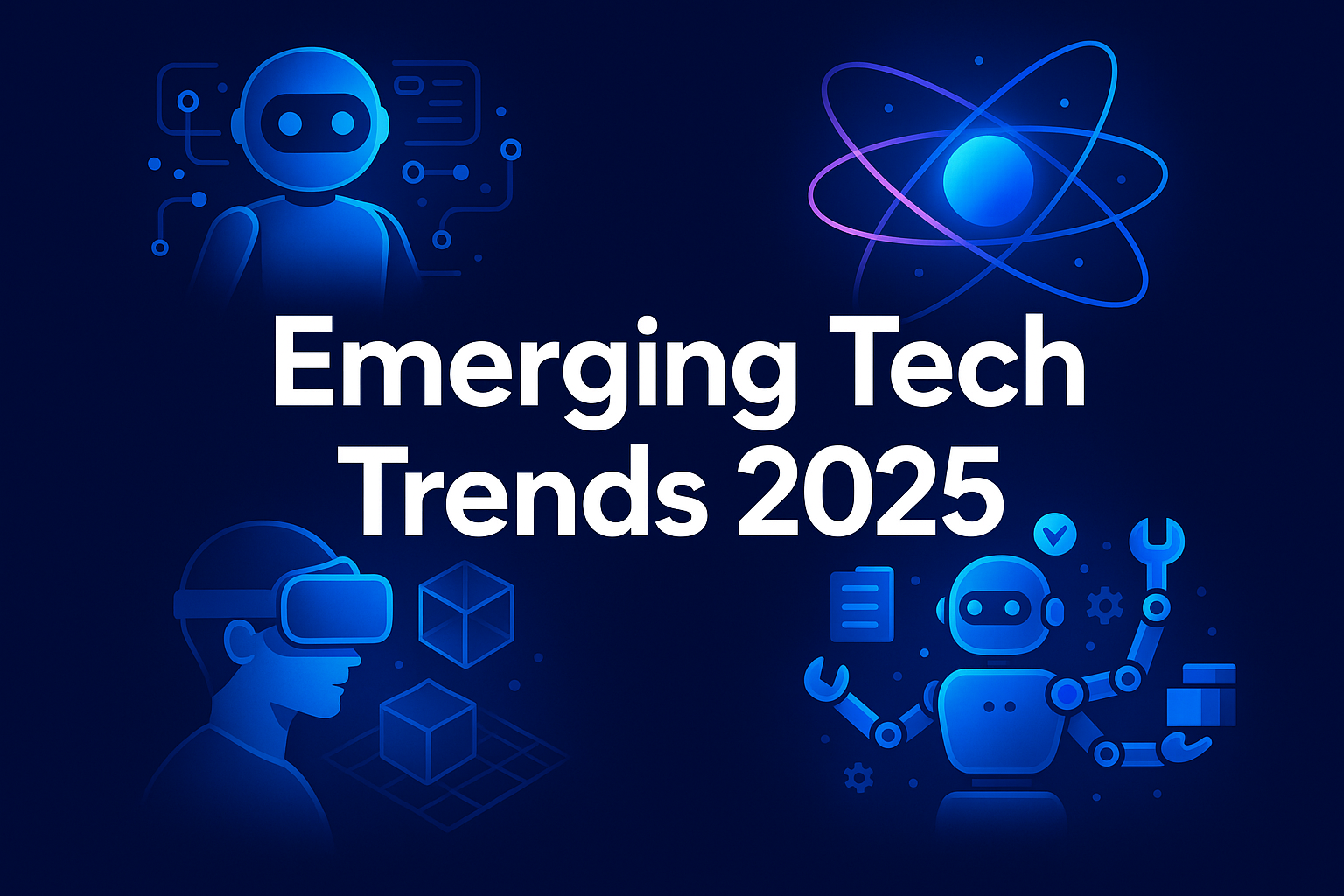
2025 is shaping up to be a pivotal year in technology. Analysts forecast that the convergence of artificial intelligence (AI), sustainability concerns and new computing paradigms will redefine how we live and work. Below are some of the most significant trends poised to shape the coming years.
Agentic AI – From Tool to Autonomous Colleague
Unlike generative AI models that respond to prompts, agentic AI (sometimes called AI agents) can make decisions and perform actions autonomously. Analysts highlight its ability to manage complex projects, automate customer interactions and speed up decision‑makingtalkspirit.com. Gartner forecasts that by 2028 at least 15 % of everyday business decisions will be made autonomously using agentic AI, up from nearly zero in 2024talkspirit.com. This shift means organisations should begin experimenting now with structured tasks that agents can manage under human supervision.
Why It Matters
- Productivity boost – AI agents work around the clock, analysing data and orchestrating tasks without waiting for a human prompttalkspirit.com.
- Complex project management – They can coordinate multi‑step workflows, fetch data and trigger follow‑up actionstalkspirit.com.
- Preparation for autonomy – Early trials help companies refine governance before agents take on high‑impact decisionstechnologymagazine.com.
AI Governance and Disinformation Security
As AI systems become more autonomous, companies must guard against bias, misinformation and misuse. AI governance platforms provide tools to evaluate models, monitor outcomes and ensure compliance with ethical standardstalkspirit.com. Gartner projects that organisations using AI governance platforms will have customer trust and regulatory compliance scores 30 % and 25 % higher, respectively, by 2028talkspirit.com.
Closely related is disinformation security – technologies designed to detect AI‑generated content, verify information and protect organisations from impersonation. By 2028 half of companies are expected to use disinformation‑security services, compared with just 5 % in 2024talkspirit.com. Implementing robust governance and misinformation countermeasures will be essential as AI agents proliferate.
Generative AI & AI Agents
Generative AI models remain a core driver of innovation. A Wavestone analysis notes that generative AI is reshaping business processes by optimising supply chains and enabling hyper‑personalised customer experienceswavestone.com. It also highlights the emergence of AI agents that go beyond conversation to manage entire workflows—pulling data, generating content and initiating actions with minimal human interventionwavestone.com. As these agents evolve from semi‑autonomous to fully autonomous, organisations will need new governance structures and risk‑management frameworkswavestone.com.
Energy‑Efficient and Hybrid Computing
Digital services consume ever‑increasing amounts of energy, especially when running large AI models. Gartner’s trend list emphasises energy‑efficient computing—technologies such as quantum, neuromorphic and GPU‑accelerated computing that aim to reduce power consumptiontalkspirit.com. Energy‑efficient infrastructures can lower data‑centre costs and help companies meet sustainability targetstalkspirit.com.
In parallel, hybrid computing combines local servers for sensitive tasks with cloud resources for compute‑intensive workloads. Hybrid setups reduce scaling costs and improve data securitytalkspirit.com. For example, a company might run confidential applications on‑premises while leveraging cloud‑based AI training during peak demandtalkspirit.com.
Quantum and Post‑Quantum Cryptography
Quantum computing continues to mature. Although still emerging, quantum algorithms promise solutions for optimisation problems, materials discovery and logisticswavestone.com. One risk is that quantum machines could eventually break today’s encryption. Post‑quantum cryptography uses algorithms that resist quantum attacks; Gartner warns that advances in quantum computing could render most asymmetric encryption obsolete by 2029talkspirit.com. Preparing for a quantum‑safe future—through research and early adoption of quantum‑resistant encryption—is therefore critical.
Spatial Computing and Polyfunctional Robots
Spatial computing blends augmented reality (AR), virtual reality (VR) and mixed reality to create immersive interactions. Companies like Apple and Meta are investing heavily, and analysts expect the spatial computing market to grow from US$110 billion in 2023 to US$1.7 trillion by 2033talkspirit.com. In business contexts, spatial computing can make remote meetings interactive and provide realistic training simulationstalkspirit.com.
Polyfunctional robots are another trend; unlike task‑specific robots, they can learn new functions and perform multiple tasks. Gartner estimates that by 2030 eight out of ten workers will rely on intelligent robots daily, up from less than one in ten todaytalkspirit.com. These robots are already used in warehouses to prepare orders, in healthcare to deliver supplies and disinfect rooms, and in the field to inspect equipment and carry out maintenancetalkspirit.com.
Towards a Human‑Centric Industry 5.0
Industry 5.0 is emerging as a human‑centred evolution of Industry 4.0. Wavestone observes that manufacturers are balancing machine precision with human creativity, integrating energy efficiency and workforce well‑being into operational performancewavestone.com. Digital workplaces are evolving to support hybrid and remote work, and companies are investing in upskilling programmes in AI, cloud, data engineering and cybersecuritywavestone.com. These initiatives ensure employees remain competitive in an increasingly automated environmentwavestone.com.
Conclusion
The technology landscape of 2025 is dominated by AI—particularly agentic AI and governance—and by next‑generation computing paradigms. Organisations that invest early in autonomous agents, ethical AI governance, energy‑efficient and hybrid computing, quantum‑safe security, spatial computing and polyfunctional robotics will be better positioned to innovate and remain competitive. At the same time, embracing human‑centred principles such as Industry 5.0 and continuous workforce development will ensure that technology augments rather than replaces human ingenuity.